AI Codes: Product Engineers Decide What to Build | Laurie Voss, Arize
npm co-founder Laurie Voss, now head of developer relations at Arize, argues that as agents take over typing code, product judgment and domain knowledge become the job. He explains why AI is the web in 1997, how the bubble pops, and why the missing junior ladder is the question of our time.
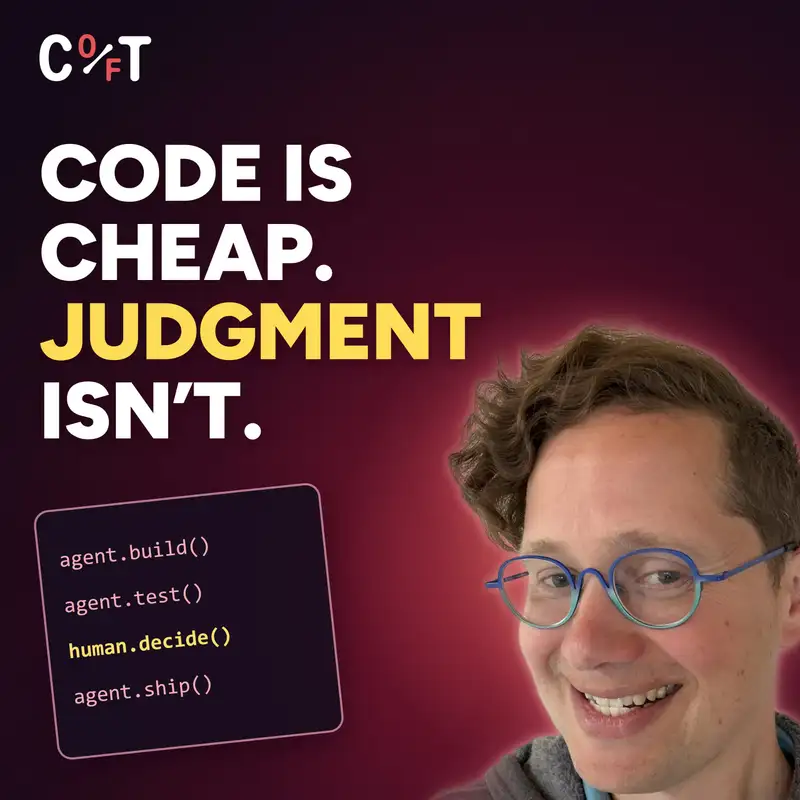
Laurie Voss co-founded npm - now head of developer relations at Arize, he argues that engineers will increasingly earn their keep as 'product engineers': understanding what users need and directing AI agents to build it.
One example: a bakery owner who knows how to make a croissant but has no interest in building software. Someone still has to turn that owner's needs into requirements. Laurie sees that work becoming central to product engineering, with cheaper code making software for narrower industries more viable.
We discuss where he still sees a need for human code review and operational knowledge, what he would look for in a computer science course if he were starting out today (and what he wouldn't do), and why he compares AI today to the web in 1997. He is optimistic about the technology and skeptical of the valuations, while leaving one question unresolved: how do junior engineers learn the judgment this work demands?
We cover:
- Why the "aha moment" of solving a problem survives even when agents type the code
- Where Laurie still sees a need for human code review, operations, and tacit knowledge
- Whether a $15,000 coding bootcamp or a theory-heavy CS degree is still worth it
- Why AI in 2026 looks like the web in 1997, and what that says about the bubble
- How AI-generated pull requests burden open source maintainers, and why Laurie expects cheaper code to pressure closed-source business models
- Why the systems analyst returns as the product engineer, and why that means niche software for bakeries and auto parts
- Why Laurie predicts open-model competition and diminishing returns could compress frontier-model margins
- How apprenticeships could help junior engineers develop product judgment
Chapters:
(0:00) The shift in software jobs
(0:44) Why Laurie is optimistic about the code generation explosion
(3:06) The aha moment moves from typing code to thinking
(5:49) Where agents still need human review and operational knowledge
(8:51) Is college still worth it?
(9:54) Bootcamps versus theory-heavy CS courses
(13:04) We are all product engineers now
(15:55) AI is the web in 1997
(18:19) Exponential growth, the labs' pause, and npm's ten-year curve
(20:07) Barring AGI, AI is a normal technology
(21:48) Block's layoffs and companies staying smaller
(23:14) What the labor data shows: fewer people, more capital
(26:29) Open source as the canary: drowning in AI pull requests
(28:11) AI reimplementations and the pressure on software moats
(30:26) Personal software and the kill-my-SaaS hackathon
(32:32) The bakery and the return of the systems analyst
(34:09) Niche software for specific industries
(35:36) Bootstrapping and the DevTools opportunity
(37:13) What this means for the model companies
(38:20) Frontier-model margins and open-model competition
(39:53) How the bubble pops: scaling laws and diminishing returns
(43:24) Staying private and the trough of disappointment
(45:51) Get good at a domain, not the technology
(50:44) The missing junior ladder is the question of our time
(53:32) Closing thoughts: it's 1997, you can retrain
(0:44) Why Laurie is optimistic about the code generation explosion
(3:06) The aha moment moves from typing code to thinking
(5:49) Where agents still need human review and operational knowledge
(8:51) Is college still worth it?
(9:54) Bootcamps versus theory-heavy CS courses
(13:04) We are all product engineers now
(15:55) AI is the web in 1997
(18:19) Exponential growth, the labs' pause, and npm's ten-year curve
(20:07) Barring AGI, AI is a normal technology
(21:48) Block's layoffs and companies staying smaller
(23:14) What the labor data shows: fewer people, more capital
(26:29) Open source as the canary: drowning in AI pull requests
(28:11) AI reimplementations and the pressure on software moats
(30:26) Personal software and the kill-my-SaaS hackathon
(32:32) The bakery and the return of the systems analyst
(34:09) Niche software for specific industries
(35:36) Bootstrapping and the DevTools opportunity
(37:13) What this means for the model companies
(38:20) Frontier-model margins and open-model competition
(39:53) How the bubble pops: scaling laws and diminishing returns
(43:24) Staying private and the trough of disappointment
(45:51) Get good at a domain, not the technology
(50:44) The missing junior ladder is the question of our time
(53:32) Closing thoughts: it's 1997, you can retrain
Connect with Laurie Voss:
- Blog: https://seldo.com/
- LinkedIn: https://www.linkedin.com/in/seldo/
- Twitter/X: https://x.com/seldo
- Bluesky: https://bsky.app/profile/seldo.com
- Arize: https://arize.com/
Connect with Chain of Thought host Conor Bronsdon:
- Newsletter: https://newsletter.chainofthought.show/
- Twitter/X: https://x.com/ConorBronsdon
- LinkedIn: https://www.linkedin.com/in/conorbronsdon/
- YouTube: https://www.youtube.com/@ConorBronsdon
Thanks to Svix, presenting sponsor of season four of Chain of Thought. Svix delivers billions of reliable webhooks for startups and the Fortune 500. Get started at https://link.svix.com/cot. Qualified startups get $12,000 in credits, and YC companies get $50,000.
Thanks to Walrus, presenting sponsor of season four of Chain of Thought. Walrus Memory gives AI agents portable, verifiable memory that carries context across apps, sessions, and other agents. Get started at https://walrus.xyz/cot
Thanks to G2i for sponsoring this episode - for over a decade, they vetted and placed engineers at other companies, from startups to FAANG. Two years ago, they turned that same judgment inward, building their own bench to review RL environments, evals, and training data that models are trained on. Get access: https://fandf.co/3SFxVm6
Thanks to Inngest, presenting sponsor of season four of Chain of Thought. Agents in production run long - they call models and wait on APIs and people. But the longer agents run, the more they break. Inngest handles that with durable execution. You build your agent as steps in TypeScript, Python, or Go. When a step fails, Inngest retries it with exponential backoff, and completed steps are saved and skipped. Try it out: https://inngest.link/cot-pod
7Mdv8UhrombOD7fnCVai
7Mdv8UhrombOD7fnCVai